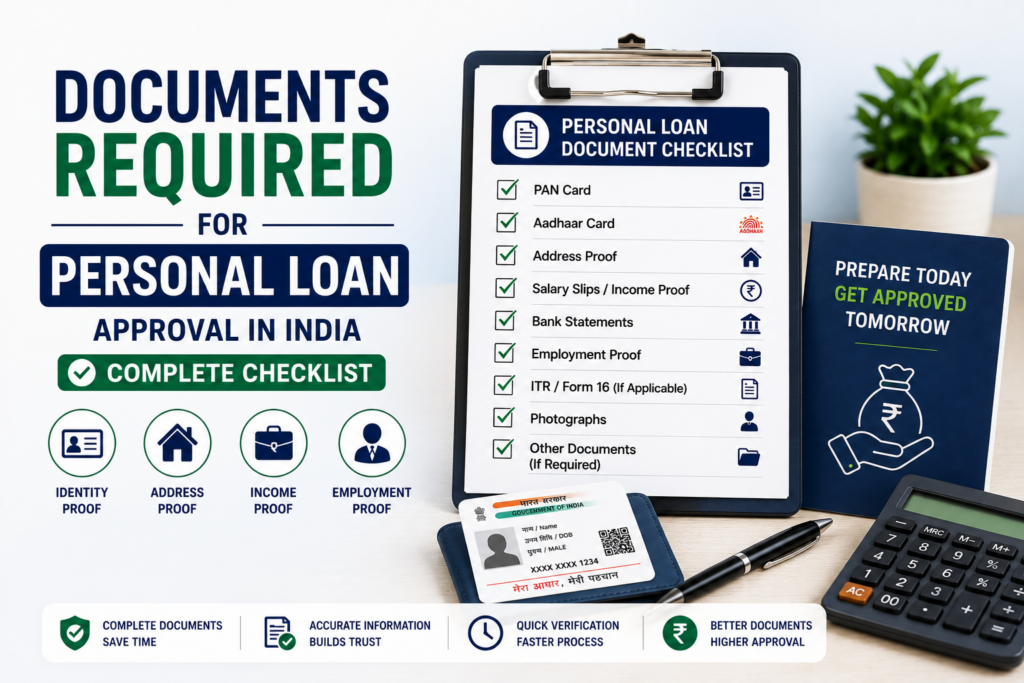
Applying for a personal loan has become easier than ever, thanks to online applications and faster approval processes. However, one of the most common reasons for delays—or even loan rejection—is incomplete or incorrect documentation.
Whether you’re applying through a bank, a non-banking financial company (NBFC), or a digital lending platform, submitting the right documents is essential for smooth processing.
Proper documentation helps lenders verify your identity, income, employment, and repayment capacity. It also speeds up the approval process and reduces the chances of additional verification requests.
In this guide, you’ll find the complete list of documents required for personal loan approval in India, understand why each document matters, and learn how to prepare your application for quicker approval.
Why Documents Are Important for Personal Loan Approval
Lenders use documents to assess whether an applicant meets their eligibility requirements and can comfortably repay the loan.
Your documents help verify:
- Your identity
- Residential address
- Income stability
- Employment details
- Financial history
- Creditworthiness
Providing clear, accurate, and up-to-date documents demonstrates reliability and helps build confidence with the lender.
Basic Documents Required for Every Personal Loan Applicant
Regardless of whether you’re salaried or self-employed, most lenders generally require the following basic documents.
1. PAN Card
A Permanent Account Number (PAN) card is one of the most important documents required for personal loan applications.
It helps lenders:
- Verify identity
- Check financial records
- Conduct credit checks
- Comply with tax regulations
Ensure that the PAN details match the information provided in your application.
2. Aadhaar Card
The Aadhaar card is widely accepted as both identity and address proof.
It also simplifies electronic KYC verification for many lenders.
Make sure your Aadhaar contains your current address whenever possible.
3. Passport-Sized Photographs
Some lenders still request recent passport-sized photographs, particularly for offline applications.
Digital applications may instead require a live selfie or photo verification.
Also Read :- How to Check Personal Loan Eligibility Before Applying in India
Address Proof Documents
Lenders need confirmation that you reside at your declared address.
Commonly accepted address proofs include:
- Aadhaar Card
- Passport
- Voter ID
- Driving Licence
- Utility Bills (subject to lender requirements)
- Rental Agreement (where accepted)
The exact list varies by lender.
Income Proof for Salaried Employees
Income verification is one of the most important stages of personal loan approval.
Salary Slips
Most lenders request recent salary slips.
These help verify:
- Monthly income
- Employer name
- Salary structure
- Employment continuity
Ensure the salary slips are recent and clearly readable.
Bank Statements
Bank statements help lenders confirm:
- Salary credits
- Monthly expenses
- Existing EMIs
- Financial discipline
Recent statements are typically preferred.
Form 16 (Where Required)
Some lenders may request Form 16 as additional proof of employment income and tax deductions.
Although not always mandatory, it can strengthen your application.
Documents Required for Self-Employed Applicants
Self-employed professionals and business owners usually need additional financial documents.
Income Tax Returns (ITRs)
Recent Income Tax Returns demonstrate declared income and financial stability.
They help lenders evaluate repayment capacity.
Business Proof
Depending on your profession, lenders may request documents such as:
- GST registration
- Business registration certificate
- Shop establishment licence
- Professional licence
Requirements vary depending on the nature of the business.
Profit and Loss Statements
Some lenders request financial statements to understand business performance and profitability.
These documents provide additional confidence regarding income consistency.
Employment Proof
Salaried applicants may also be asked to provide employment verification.
This could include:
- Employee ID card
- Employment certificate
- Appointment letter
- Employer verification (where applicable)
Long-term employment often strengthens an application.
Also Read :- How to Increase CIBIL Score from 650 to 750
Credit History Documents
Although lenders usually retrieve credit reports directly from credit bureaus, applicants should review their own credit reports before applying.
Check for:
- Incorrect information
- Outstanding dues
- Payment history
- Credit score
Resolving errors beforehand can improve approval chances.
Additional Documents That Some Lenders May Request
Depending on the loan amount and applicant profile, additional documentation may be required.
Examples include:
- Existing loan statements
- Investment proof
- Property documents (in special cases)
- Co-applicant documents
- Guarantor details (where applicable)
Providing these promptly can help avoid unnecessary delays.
Digital Documents for Online Loan Applications
Many lenders now support completely digital applications.
You may be asked to upload:
- Scanned PAN Card
- Scanned Aadhaar Card
- Digital salary slips
- PDF bank statements
- Live selfie
- Electronic signatures
Ensure uploaded files are clear, complete, and legible to prevent verification issues.
Checklist for Salaried Employees
Make sure you have the following:
- ✅ PAN Card
- ✅ Aadhaar Card or other valid address proof
- ✅ Recent passport-sized photographs (if required)
- ✅ Recent salary slips
- ✅ Recent bank statements showing salary credits
- ✅ Form 16 (if requested)
- ✅ Employee ID card or employment proof (where applicable)
Having these documents ready can significantly speed up the approval process.
Checklist for Self-Employed Applicants
Business owners and self-employed professionals should generally keep these documents ready:
- ✅ PAN Card
- ✅ Aadhaar Card
- ✅ Address proof
- ✅ Recent Income Tax Returns (ITRs)
- ✅ Business registration proof (if applicable)
- ✅ GST registration (where applicable)
- ✅ Recent bank statements
- ✅ Profit and Loss Statement (if requested)
The exact requirements depend on the lender and the nature of your business.
Also Read :- 10 Common Reasons Personal Loans Get Rejected in India (And How to Avoid Them)
Common Document Mistakes That Delay Loan Approval
Even eligible applicants sometimes experience delays because of documentation errors.
Here are some of the most common mistakes:
Uploading Blurry Documents
Poor-quality scans or unclear photographs may fail verification.
Tip: Upload high-resolution, clearly readable copies.
Mismatched Information
Your name, date of birth, and address should match across all submitted documents.
Even small spelling differences can trigger additional verification.
Outdated Address Proof
If you’ve changed your residence recently, ensure your address proof is updated or provide another acceptable document.
Missing Pages in Bank Statements
Some applicants upload only the first page of their bank statement.
Lenders often require complete statements for the requested period.
Expired Documents
Always verify that documents such as driving licences or passports (if used as proof) remain valid.
Tips for Faster Personal Loan Approval
Submitting documents is only one part of the application process.
These tips can help improve your chances of quicker approval:
Organize Documents Before Applying
Create a folder containing all required documents before starting your application.
This reduces the chances of forgetting something important.
Ensure Information Is Accurate
Double-check:
- Name spelling
- Mobile number
- Email address
- PAN details
- Aadhaar number
Accuracy helps prevent unnecessary delays.
Maintain a Healthy CIBIL Score
While documentation is important, lenders also consider your credit profile.
Pay existing EMIs and credit card bills on time to strengthen your application.
Apply Through Trusted Lenders
Choose banks or regulated financial institutions with transparent eligibility criteria and document requirements.
Respond Quickly to Verification Requests
If the lender requests additional documents or clarification, respond promptly to keep the application moving.
Online vs Offline Document Submission
Most lenders now offer both online and offline application options.
Online Applications
Benefits include:
- Faster document upload
- Digital KYC
- Paperless process
- Real-time application tracking
Offline Applications
Some borrowers still prefer visiting a branch, especially for assistance with documentation or complex applications.
Choose the method that best suits your comfort level.
Frequently Asked Questions
Are Aadhaar and PAN mandatory for a personal loan?
Most lenders require both PAN and Aadhaar (or other acceptable identity and address proof) as part of the verification process. Requirements may vary slightly between institutions.
Do all lenders require salary slips?
Most lenders ask salaried applicants for recent salary slips to verify income. Some may accept alternative income proof depending on their policies.
Can I apply without Income Tax Returns?
Salaried applicants are often not required to submit ITRs unless specifically requested. Self-employed applicants are more likely to need them as proof of income.
Are scanned copies accepted for online applications?
Yes.
Most online lenders accept clear scanned copies or high-quality photographs of documents for digital verification.
How long does document verification take?
Verification timelines vary depending on the lender, document completeness, and whether additional verification is required.
Expert Advice
Many borrowers focus only on eligibility and interest rates but overlook documentation.
In reality, incomplete or inaccurate paperwork is one of the easiest issues to avoid.
Before applying:
- Review the lender’s document checklist.
- Verify every document is current and readable.
- Keep digital copies ready.
- Ensure information matches across all records.
Good preparation often leads to a smoother and faster approval experience.
Final Thoughts
Submitting the correct documents is one of the most important steps in obtaining a personal loan in India.
Whether you’re applying online or visiting a bank branch, complete and accurate documentation helps lenders verify your identity, income, and repayment capacity efficiently.
By preparing your paperwork in advance, checking that all information is consistent, and responding quickly to any additional requests, you can reduce delays and improve your overall borrowing experience.
A well-organized application not only saves time but also increases your confidence throughout the loan process.
Key Takeaways
- Keep all KYC documents updated and ready.
- Prepare separate document sets based on your employment type.
- Ensure names and addresses match across all records.
- Upload clear, complete copies of every document.
- Review your CIBIL score before applying.
- Respond promptly to lender verification requests.
- Organized documentation can speed up loan approval.