Artificial Intelligence is no longer a niche technology reserved for software engineers and researchers. It’s transforming industries across the globe—from healthcare and finance to education, marketing, manufacturing, and customer service.
As AI continues to evolve, employers are looking for professionals who understand how to work alongside intelligent systems rather than compete against them.
Whether you’re a student, freelancer, digital marketer, entrepreneur, or working professional, developing AI-related skills can significantly improve your career opportunities and future earning potential.
The best part? You don’t need to become an AI scientist to benefit from this technology.
Many of today’s most valuable AI skills involve using AI tools effectively, automating workflows, creating better content, analyzing data, and solving business problems.
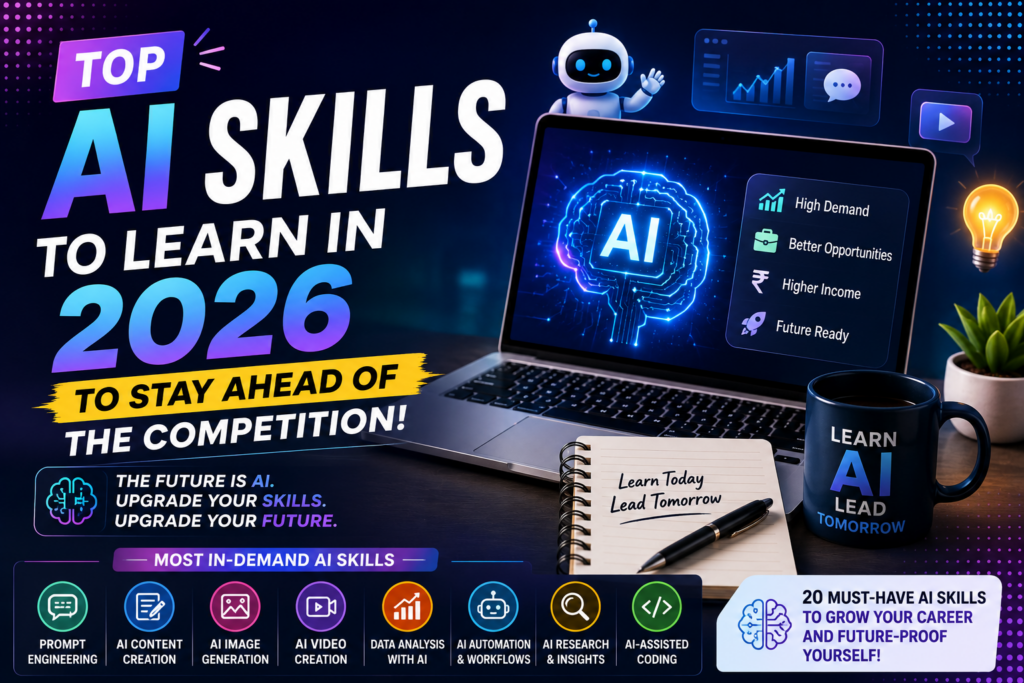
In this guide, we’ll explore the top AI skills to learn in 2026 and explain why each one matters in today’s rapidly changing job market.
Why Learning AI Skills Matters
AI is changing how businesses operate.
Tasks that once required hours of manual work can now be completed in minutes with the right AI tools.
Companies increasingly value professionals who know how to:
- Improve productivity
- Automate repetitive work
- Analyze information quickly
- Create better customer experiences
- Use AI responsibly
Learning AI skills doesn’t mean replacing human creativity—it means enhancing it.
1. Prompt Engineering
One of the fastest-growing AI skills is prompt engineering.
Prompt engineering is the ability to communicate effectively with AI systems by writing clear, detailed, and structured instructions.
A well-written prompt can dramatically improve the quality of AI-generated content.
Professionals use prompt engineering for:
- Content writing
- Marketing campaigns
- Coding assistance
- Research
- Business planning
- Customer support
Why It Matters
Knowing how to ask better questions often leads to better AI-generated results, making prompt engineering a valuable skill across many industries.
2. AI Content Creation
AI has become a powerful assistant for creating:
- Blog posts
- Social media content
- Email newsletters
- Product descriptions
- Marketing copy
- Video scripts
However, successful creators don’t simply copy AI-generated text.
They combine AI efficiency with human creativity, editing, and expertise to produce high-quality, original content.
Recommended Skills
- SEO writing
- AI editing
- Storytelling
- Content strategy
Also Read :- Best AI Tools for Content Creators in 2026
3. AI Image Generation
Visual content continues to dominate digital platforms.
Learning how to generate high-quality AI images is becoming an increasingly valuable skill.
Applications include:
- Blog illustrations
- YouTube thumbnails
- Advertising creatives
- Social media graphics
- Product mockups
Creators who understand composition, branding, and prompt writing often produce the best results.
4. AI Video Creation
Short-form video remains one of the fastest-growing content formats.
Modern AI tools can help with:
- Video editing
- Caption generation
- Background removal
- Script writing
- Voiceovers
- Automatic translations
Businesses increasingly seek professionals who can create engaging videos quickly using AI-assisted workflows.
5. AI Research Skills
Finding accurate information is becoming just as important as creating content.
AI-powered research tools help professionals:
- Summarize lengthy documents
- Compare information
- Analyze trends
- Discover insights
- Save hours of manual research
The ability to verify AI-generated information is equally important.
Critical thinking remains an essential skill.
6. AI Automation
Automation is transforming workplaces.
Professionals who understand how to automate repetitive tasks can significantly improve efficiency.
Examples include:
- Email automation
- Content scheduling
- Customer support workflows
- Data organization
- Report generation
Even small automations can save businesses hundreds of hours each year.
Also Read :- Best Free AI Tools for Students in 2026
7. AI Data Analysis
Businesses generate enormous amounts of data every day.
AI-powered analytics tools help professionals:
- Identify trends
- Build reports
- Forecast demand
- Understand customer behavior
- Make informed decisions
Data literacy combined with AI is becoming valuable in nearly every industry.
8. AI-Assisted Coding
Developers increasingly use AI to:
- Write code faster
- Debug programs
- Generate documentation
- Explain complex code
- Improve productivity
Even non-programmers benefit from understanding basic coding concepts alongside AI tools.
9. AI-Powered SEO
Search engine optimization is evolving rapidly.
AI now assists with:
- Keyword research
- Content optimization
- Competitor analysis
- Internal linking
- Meta descriptions
- Content planning
Digital marketers who combine SEO knowledge with AI tools gain a significant competitive advantage.
10. AI Productivity Management
Beyond content creation, AI helps professionals organize their daily work.
Applications include:
- Meeting summaries
- Task management
- Calendar planning
- Project organization
- Note-taking
- Knowledge management
Learning to integrate AI into everyday workflows can dramatically increase productivity without increasing working hours.
Skills vs Tools
One common misconception is that learning AI means memorizing specific software.
In reality, tools change frequently.
The real competitive advantage comes from learning transferable skills such as:
- Problem-solving
- Prompt writing
- Critical thinking
- Creativity
- Communication
- Data interpretation
Once you master these skills, adapting to new AI platforms becomes much easier.
11. AI Workflow Design
Using AI tools individually is useful, but connecting them into a complete workflow is even more valuable.
For example, a content creator might use AI to:
- Research a topic
- Generate an article outline
- Write the first draft
- Create featured images
- Design social media posts
- Schedule content
Professionals who can build efficient AI-powered workflows help businesses save time and improve productivity.
12. AI Presentation Skills
Creating presentations no longer requires hours of manual work.
AI can help generate:
- Business presentations
- Sales decks
- Educational slides
- Reports
- Pitch decks
Learning how to refine AI-generated presentations and tailor them to your audience is becoming a valuable workplace skill.
13. AI Voice and Audio Production
AI-powered voice technology is improving rapidly.
Professionals can now create:
- Podcast narration
- Audiobooks
- Voiceovers
- Training materials
- Video narration
Understanding audio quality, scripting, and editing remains essential even when AI generates the voice.
14. AI-Powered Customer Support
Many businesses now use AI chatbots and virtual assistants to improve customer service.
Useful skills include:
- Designing chatbot conversations
- Creating knowledge bases
- Writing customer-friendly responses
- Optimizing automated support flows
These abilities are valuable in ecommerce, SaaS, banking, and many other industries.
15. AI Ethics and Responsible Use
As AI becomes more common, responsible use becomes increasingly important.
Professionals should understand:
- Data privacy
- Copyright considerations
- Bias in AI systems
- Transparency
- Human oversight
Employers value people who can use AI effectively while maintaining ethical standards.
16. AI for Business Decision-Making
Managers and entrepreneurs are increasingly using AI to support decision-making.
AI can assist with:
- Sales forecasting
- Market research
- Competitor analysis
- Customer insights
- Business planning
The ability to interpret AI-generated insights rather than relying on them blindly is an important leadership skill.
17. AI-Powered Digital Marketing
Modern marketers use AI to improve:
- Advertising campaigns
- Audience targeting
- Email marketing
- Content personalization
- Performance analysis
Understanding how AI complements marketing strategy can help professionals deliver stronger campaign results.
18. AI Collaboration Skills
One of the most overlooked AI skills is collaboration.
The future workplace will involve people working alongside AI systems every day.
Successful professionals know when to:
- Ask AI for assistance
- Review AI-generated output
- Add human expertise
- Make final decisions
AI works best as a partner—not a replacement for human judgment.
19. Continuous AI Learning
AI changes quickly.
New models, features, and tools are released regularly.
Developing the habit of continuous learning helps you stay relevant and adapt to changes in technology.
Simple habits include:
- Reading industry blogs
- Following AI newsletters
- Watching tutorials
- Experimenting with new tools
- Joining online communities
20. Problem-Solving with AI
Ultimately, AI is most valuable when it helps solve real-world problems.
Instead of focusing only on specific tools, learn how to ask:
- What problem am I trying to solve?
- Can AI make this task faster?
- Can AI improve quality?
- Does this process still need human review?
Professionals who combine critical thinking with AI skills will remain valuable regardless of how technology evolves.
How to Start Learning AI Skills
You don’t need an expensive degree to begin learning AI.
A practical learning path might look like this:
Step 1
Learn the basics of AI and understand how modern AI tools work.
Step 2
Practice prompt writing with different AI assistants.
Step 3
Explore AI tools for writing, design, research, and productivity.
Step 4
Apply AI to real projects instead of only watching tutorials.
Step 5
Build a portfolio that demonstrates how you’ve used AI to solve problems or improve workflows.
Consistent practice is often more valuable than collecting certificates.
Common Mistakes Beginners Make
Avoid these common pitfalls:
- Trying too many AI tools at once.
- Depending entirely on AI without reviewing the output.
- Ignoring fact-checking.
- Learning tools instead of transferable skills.
- Failing to keep up with new developments.
Focus on mastering the fundamentals before expanding your toolkit.
Frequently Asked Questions
Do I need programming skills to learn AI?
No.
Many valuable AI skills—such as prompt engineering, content creation, research, and workflow automation—can be learned without programming knowledge.
Which AI skill has the highest demand?
Demand varies by industry, but prompt engineering, AI-assisted content creation, workflow automation, data analysis, and AI-powered digital marketing are among the most sought-after skills in 2026.
Can AI skills help freelancers?
Absolutely.
Freelancers can use AI to improve productivity, create better client deliverables, reduce repetitive work, and take on more projects efficiently.
Will AI replace jobs?
AI is changing how work is performed rather than replacing every role. Professionals who learn to work effectively with AI are likely to have stronger career opportunities than those who ignore it.
How long does it take to learn AI skills?
The basics can be learned in a few weeks with regular practice. Developing advanced, practical skills takes longer and benefits from applying AI to real-world projects.
Final Thoughts
Artificial Intelligence is no longer a technology of the future—it’s a core part of today’s workplace. The professionals who thrive in 2026 won’t necessarily be those who know the most AI tools, but those who understand how to use AI to solve problems, improve productivity, and create meaningful value.
Whether you’re a student preparing for your first job, a freelancer looking to work more efficiently, or a business owner aiming to stay competitive, investing time in AI skills is an investment in your future.
Start with one or two skills, practice consistently, and focus on applying what you learn. As AI continues to evolve, adaptability and continuous learning will remain your greatest competitive advantages.
Key Takeaways
- AI skills are becoming valuable across almost every industry.
- Prompt engineering is one of the fastest-growing skills.
- Combine AI with creativity, critical thinking, and communication.
- Focus on transferable skills rather than specific tools.
- Build practical experience through real-world projects.
- Continue learning as AI technology evolves.