Artificial Intelligence (AI) has become one of the most talked-about technologies in the world. From writing emails and creating images to helping doctors diagnose diseases and assisting businesses with customer support, AI is transforming nearly every industry.
Yet despite its rapid growth, many misconceptions continue to surround AI. Social media posts, movies, sensational headlines, and misinformation often exaggerate what AI can actually do. As a result, many people either fear AI unnecessarily or expect it to perform miracles that simply aren’t possible.
Understanding the reality behind AI is important for everyone—not just developers or technology professionals. Whether you’re a student, business owner, marketer, healthcare worker, or someone curious about technology, separating fact from fiction helps you make better decisions.
In this comprehensive guide, we’ll debunk the most common AI myths and explain what today’s artificial intelligence is truly capable of.
Why AI Myths Continue to Spread
AI evolves faster than most people can keep up with. Every few months, new tools appear that perform tasks once thought impossible.
This rapid progress creates confusion because:
- Movies portray AI as human-like robots.
- Social media exaggerates AI capabilities.
- Companies overmarket AI-powered products.
- People confuse automation with intelligence.
- Headlines often prioritize clicks over accuracy.
The result is a growing list of myths that make AI seem either magical or dangerous.
Let’s separate reality from fiction.
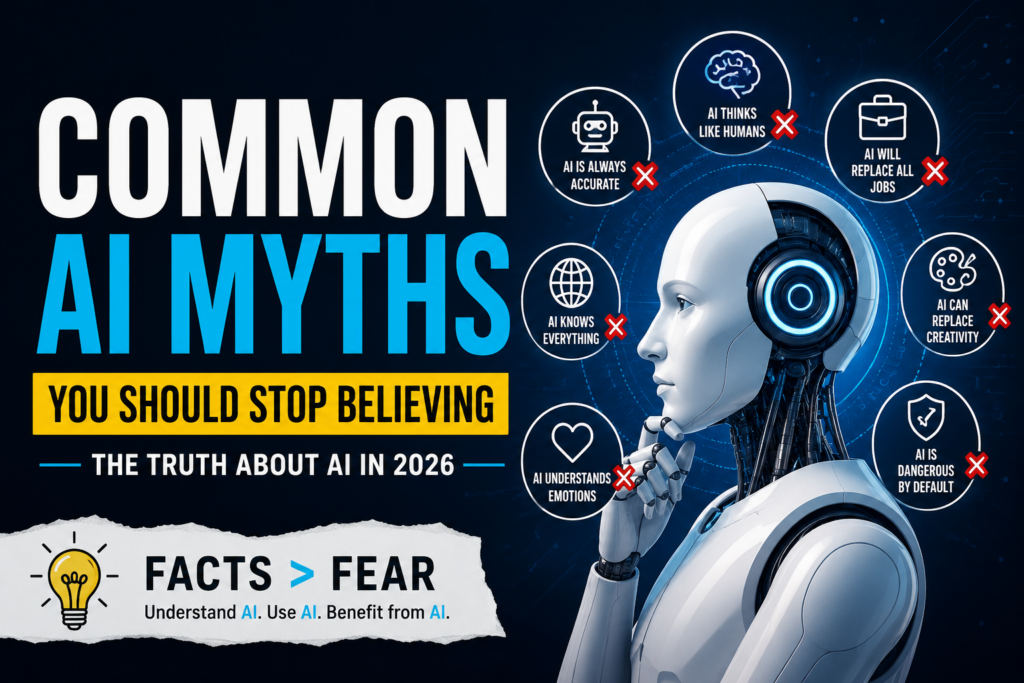
Myth 1: AI Thinks Like Humans
This is perhaps the biggest misconception.
Many people believe AI has thoughts, emotions, opinions, and consciousness.
The Reality
Today’s AI doesn’t “think.”
Instead, AI identifies patterns from enormous amounts of data and predicts the most likely answer based on what it has learned.
For example:
When ChatGPT answers your question, it isn’t thinking about the answer like a person would.
It predicts which words are most likely to come next based on patterns learned during training.
Similarly:
- AI image generators predict visual patterns.
- AI translators predict language patterns.
- AI coding assistants predict programming patterns.
AI appears intelligent because pattern prediction has become incredibly sophisticated—not because it possesses consciousness.
Also Read :- 20 AI Prompts Everyone Should Know in 2026
Myth 2: AI Will Replace Every Human Job
This fear has existed since computers first entered workplaces.
Many believe AI will eliminate nearly every profession.
The Reality
AI is changing jobs—not eliminating all of them.
Historically, technology has always automated repetitive work while creating new career opportunities.
Examples include:
- Bank ATMs didn’t eliminate banking.
- Email didn’t eliminate communication professionals.
- Computers didn’t eliminate accountants.
- Online shopping didn’t eliminate logistics jobs.
Instead, jobs evolved.
AI is expected to automate repetitive, predictable, and time-consuming tasks such as:
- Data entry
- Scheduling
- Basic customer service
- Report generation
- Document summarization
However, human skills remain difficult to replace, including:
- Leadership
- Critical thinking
- Creativity
- Emotional intelligence
- Negotiation
- Strategic planning
- Ethical decision-making
Workers who learn to use AI effectively are likely to become more productive rather than obsolete.
Myth 3: AI Is Always Accurate
Many users assume AI never makes mistakes.
This is dangerous.
The Reality
AI can confidently generate incorrect information.
This phenomenon is sometimes called an “AI hallucination.”
Examples include:
- Inventing fake citations
- Misunderstanding questions
- Producing outdated facts
- Incorrect calculations
- Misidentifying objects in images
Because AI generates responses based on probability, it may sound convincing even when wrong.
Always verify important information involving:
- Medical advice
- Legal matters
- Financial planning
- Academic research
- Government regulations
AI should assist human decision-making—not replace it.
Myth 4: AI Knows Everything
Some people believe AI has unlimited knowledge.
The Reality
AI has limitations.
Depending on the system:
- Knowledge may have a cutoff date.
- Live internet access may not exist.
- Specialized industry knowledge may be incomplete.
- Local regulations may be outdated.
- Recent news may be unavailable.
Even AI systems connected to the internet can misunderstand or misinterpret information.
Think of AI as a powerful assistant—not an all-knowing encyclopedia.
Myth 5: AI Is Completely Objective
Many assume AI is unbiased because computers are mathematical.
The Reality
AI learns from human-created data.
If training data contains bias, AI can sometimes reflect those biases.
Examples include:
- Hiring recommendations
- Image generation
- Language translation
- Facial recognition
- Credit scoring
This is why responsible AI development includes:
- Bias testing
- Human oversight
- Diverse training data
- Ethical guidelines
- Continuous evaluation
AI is a tool built by humans, and human imperfections can influence its outputs.
Myth 6: AI Can Replace Human Creativity
Some artists, writers, and designers worry creativity will disappear.
The Reality
AI can generate creative content—but creativity itself remains deeply human.
AI can help create:
- Images
- Draft articles
- Music
- Videos
- Marketing copy
- Story ideas
However, humans provide:
- Original vision
- Emotional storytelling
- Cultural understanding
- Brand identity
- Personal experience
- Purpose
The best creative work increasingly combines human imagination with AI assistance.
Myth 7: AI Is Only for Large Tech Companies
Many small business owners believe AI is too expensive or complicated.
The Reality
AI has become accessible to businesses of all sizes.
Today, small businesses use AI for:
- Customer support chatbots
- Email marketing
- Social media scheduling
- Content creation
- Sales automation
- Meeting summaries
- Data analysis
Also Read :- How to Use AI to Boost Productivity at Work
Many AI tools even offer free plans suitable for startups and freelancers.
AI is no longer limited to billion-dollar companies.
Myth 8: AI Is Just Another Trend
Some believe AI is simply another temporary technology buzzword.
The Reality
AI is becoming foundational technology.
Just like:
- Electricity
- The internet
- Smartphones
- Cloud computing
AI is gradually integrating into everyday software.
You may already use AI without realizing it:
- Search engines
- Maps
- Email spam filters
- Voice assistants
- Online shopping recommendations
- Banking fraud detection
- Streaming recommendations
Rather than disappearing, AI is becoming invisible infrastructure powering many digital experiences.
Myth 9: AI Can Learn Completely on Its Own
Movies often show AI continuously becoming smarter without human involvement.
The Reality
AI requires significant human effort.
Humans are responsible for:
- Collecting data
- Cleaning datasets
- Building algorithms
- Training models
- Testing performance
- Monitoring outputs
- Updating systems
- Ensuring safety
Even self-learning systems operate within rules created by humans.
AI doesn’t independently decide to reinvent itself.
Myth 10: AI Understands Emotions
AI chatbots often sound empathetic.
This leads many people to believe AI experiences emotions.
The Reality
AI recognizes emotional patterns—it doesn’t feel emotions.
When AI says:
“I’m sorry you’re going through that.”
It generates language that matches similar situations in its training data.
It does not experience:
- Happiness
- Fear
- Love
- Empathy
- Sadness
- Excitement
The emotional understanding comes from language prediction rather than genuine feelings.
Myth 11: AI Is Dangerous by Default
Hollywood has heavily influenced public perception.
Many movies portray AI as humanity’s greatest threat.
The Reality
AI itself is neither good nor bad.
Like electricity or the internet, its impact depends on how humans use it.
Positive applications include:
- Detecting diseases earlier
- Supporting scientific research
- Improving accessibility
- Enhancing education
- Increasing workplace productivity
- Reducing repetitive work
- Optimizing transportation
Potential risks include:
- Deepfakes
- Scams
- Privacy misuse
- Misinformation
- Cybersecurity threats
Responsible governance, transparency, and ethical development are essential to maximizing benefits while reducing risks.
Myth 12: Using AI Is Cheating
Students and professionals sometimes worry any AI use is unethical.
The Reality
It depends on how AI is used.
Responsible AI use includes:
- Brainstorming ideas
- Grammar improvement
- Draft generation
- Coding assistance
- Research organization
- Language translation
- Learning new concepts
Unethical use includes:
- Plagiarism
- Submitting AI-generated work as entirely your own when prohibited
- Fabricating research
- Academic dishonesty
AI should enhance learning—not replace genuine effort.
Myth 13: AI Doesn’t Need Human Supervision
Some businesses believe AI can run independently once deployed.
The Reality
Successful AI systems require continuous monitoring.
Organizations regularly:
- Evaluate accuracy
- Update models
- Review outputs
- Correct mistakes
- Improve security
- Test fairness
- Monitor compliance
Human oversight remains one of the most important parts of responsible AI deployment.
Myth 14: AI Will Eliminate Human Decision-Making
Many assume AI should make every important decision.
The Reality
AI supports decisions—it shouldn’t automatically replace human judgment.
Professionals still make final decisions in fields like:
- Healthcare
- Law
- Finance
- Engineering
- Education
- Human Resources
AI provides recommendations, but experienced professionals consider context, ethics, and real-world consequences before acting.
Myth 15: You Need to Be a Programmer to Use AI
Many people avoid AI because they believe it’s only for software engineers.
The Reality
Modern AI tools are designed for everyday users.
Today you can use AI by simply typing natural language.
People using AI daily include:
- Teachers
- Students
- Writers
- Designers
- Accountants
- Small business owners
- Marketers
- Healthcare professionals
- Real estate agents
- Customer support teams
No coding knowledge is required for most popular AI applications.
How to Use AI Responsibly
Understanding AI’s strengths and limitations helps you use it effectively.
Here are some best practices:
- Verify important facts before acting.
- Protect sensitive personal and business information.
- Use AI as an assistant rather than a replacement for expertise.
- Review AI-generated content before publishing.
- Stay informed about updates and limitations.
- Follow your workplace or school’s AI usage policies.
- Keep learning as AI technology evolves.
Responsible use leads to better results and reduces the risk of errors.
The Future of AI
Artificial intelligence will continue to improve over the coming years.
We can expect advancements in:
- Personalized education
- Healthcare diagnostics
- Scientific discovery
- Robotics
- Autonomous systems
- Creative collaboration
- Workplace productivity
- Accessibility technologies
However, human skills such as creativity, empathy, ethical reasoning, leadership, and critical thinking will remain essential. The future is unlikely to be humans versus AI—instead, it will increasingly be humans working alongside AI to solve complex problems.
Final Thoughts
Artificial intelligence is one of the most powerful technologies of our time, but it’s often misunderstood. Believing myths can lead to unnecessary fear, unrealistic expectations, or poor decisions about how to use AI.
The reality is that AI is a sophisticated tool—not a conscious being, not an all-knowing expert, and not a replacement for human judgment. It excels at recognizing patterns, automating repetitive tasks, and assisting with creativity and productivity, but it still depends on human guidance, oversight, and expertise.
As AI becomes more integrated into everyday life, the most valuable skill won’t be avoiding AI—it will be understanding what it can and cannot do. By separating fact from fiction, you can use AI more confidently, responsibly, and effectively in both your personal and professional life.
Frequently Asked Questions (FAQs)
1. What is the biggest myth about AI?
One of the biggest myths is that AI thinks like humans. In reality, modern AI predicts patterns based on data and does not possess consciousness or emotions.
2. Will AI replace all jobs?
No. AI is expected to automate many repetitive tasks, but human skills such as creativity, leadership, empathy, and strategic thinking remain highly valuable.
3. Can AI make mistakes?
Yes. AI can produce inaccurate or fabricated information, so important facts should always be verified through reliable sources.
4. Is AI only useful for tech professionals?
No. AI tools are widely used by students, teachers, marketers, healthcare workers, writers, entrepreneurs, and many other professionals.
5. Is using AI unethical?
Not necessarily. Using AI for brainstorming, editing, research, and productivity is generally acceptable. Ethical concerns arise when AI is used for plagiarism, deception, or violating institutional policies.
6. What is the best way to use AI?
Use AI as a productivity assistant, verify critical information, protect sensitive data, and combine AI-generated insights with your own expertise and judgment.