Blogging has changed dramatically over the last few years.
Creating a successful blog today isn’t just about writing good content. Bloggers also need to perform keyword research, write SEO-friendly articles, create engaging headlines, optimize images, write social media posts, respond to readers, and consistently publish fresh content.
Managing all these tasks can quickly become overwhelming.
That’s where ChatGPT comes in.
When used correctly, ChatGPT isn’t a replacement for creativity—it’s a productivity tool that helps bloggers work faster, overcome writer’s block, and generate better ideas.
The secret isn’t simply asking ChatGPT to “write an article.”
The quality of your results depends heavily on the prompts you use.
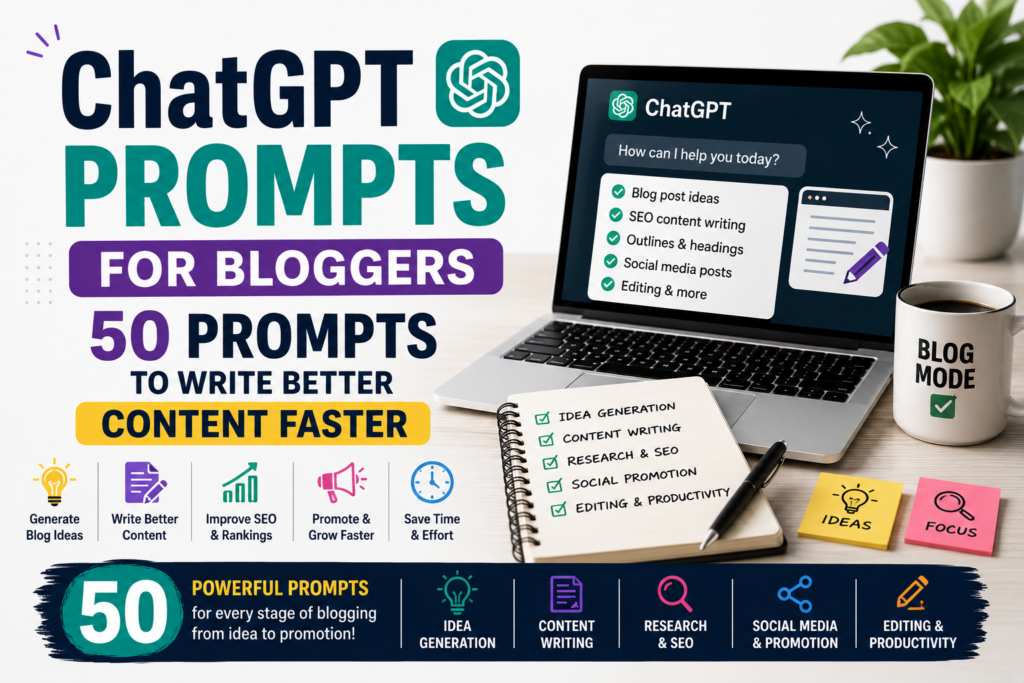
In this guide, you’ll discover 50 powerful ChatGPT prompts for bloggers that can help you create better content, improve SEO, save time, and become more productive.
Why Bloggers Should Use ChatGPT
Many bloggers think ChatGPT is only useful for writing articles.
In reality, it can help with almost every stage of content creation.
Some examples include:
- Finding blog ideas
- Performing keyword research
- Creating outlines
- Writing introductions
- Improving readability
- Writing FAQs
- Generating meta descriptions
- Creating social media captions
- Repurposing blog posts
- Editing existing content
Instead of replacing your writing, ChatGPT helps eliminate repetitive tasks so you can focus on creating valuable content.
How to Get Better Results from ChatGPT
Before jumping into the prompts, it’s important to understand one thing.
Poor prompts produce average results.
Detailed prompts produce significantly better responses.
For example, instead of asking:
Write an article about SEO.
Try asking:
Write a 2,000-word beginner-friendly article about SEO for small business owners. Use simple language, include H2 headings, FAQs, practical examples, and optimize for the keyword “SEO for small businesses.”
The more context you provide, the better the output.
Also Read :- Best AI Tools for Content Creators in 2026
50 Best ChatGPT Prompts for Bloggers
Blog Idea Generation
Prompt 1
Generate 50 blog post ideas for a website in the [your niche] industry that target beginner readers.
Prompt 2
Suggest trending blog topics that have high search demand but low competition.
Prompt 3
Generate evergreen blog ideas that will remain relevant for years.
Prompt 4
Create blog topic ideas based on frequently asked questions in my niche.
Prompt 5
Generate list-style blog post ideas that attract high click-through rates.
Prompt 6
Suggest blog ideas based on seasonal events and upcoming holidays.
Prompt 7
Give me blog ideas that solve common problems faced by [target audience].
Prompt 8
Generate blog ideas that are likely to perform well on Pinterest.
Prompt 9
Suggest comparison articles my audience would find useful.
Prompt 10
Generate content ideas based on Google’s People Also Ask questions.
SEO Content Writing Prompts
Prompt 11
Create a detailed SEO article outline targeting the keyword [keyword].
Prompt 12
Write a compelling blog introduction that immediately captures the reader’s attention.
Prompt 13
Generate SEO-friendly H2 and H3 headings for my article.
Prompt 14
Write a conclusion that encourages readers to take action.
Prompt 15
Generate an SEO title with a high click-through rate.
Prompt 16
Write an engaging meta description under 160 characters.
Also Read :- Top AI Skills to Learn in 2026 to Stay Ahead of the Competition
Prompt 17
Suggest semantic keywords related to [main keyword].
Prompt 18
Generate frequently asked questions based on my target keyword.
Prompt 19
Rewrite this paragraph in a more natural, conversational tone without changing its meaning.
Prompt 20
Improve this article for readability while maintaining SEO optimization.
Content Research Prompts
Prompt 21
Summarize the latest trends related to [topic].
Prompt 22
Explain this complex topic in simple language suitable for beginners.
Prompt 23
List the biggest mistakes people make regarding [topic].
Prompt 24
Generate practical examples I can include in my article.
Prompt 25
Suggest reliable statistics I should research and include in this article.
Prompt 26
Create a comparison table for [Topic A] vs [Topic B].
Prompt 27
Generate common myths about [topic] and explain the truth behind each.
Prompt 28
Suggest expert tips readers can immediately apply.
Prompt 29
Generate actionable checklists for this article.
Prompt 30
Identify content gaps that competitors often miss.
Social Media Promotion Prompts
Prompt 31
Turn this blog post into a LinkedIn post that sounds professional and encourages discussion.
Prompt 32
Create an engaging Facebook post promoting this article with a strong hook.
Prompt 33
Write an Instagram caption for this blog article using a conversational tone and relevant hashtags.
Prompt 34
Generate five X (Twitter) posts from this article that encourage clicks.
Prompt 35
Create a Pinterest pin title and description optimized for search.
Prompt 36
Write a YouTube Community post promoting this blog article.
Prompt 37
Generate an email newsletter introducing this article to subscribers.
Prompt 38
Create five click-worthy headlines for social media promotion.
Prompt 39
Write a short promotional message for WhatsApp or Telegram.
Prompt 40
Repurpose this blog article into a short video script suitable for Instagram Reels or YouTube Shorts.
Productivity & Editing Prompts
Prompt 41
Rewrite this article in a more conversational, human-like tone without changing the meaning.
Prompt 42
Proofread this article for grammar, spelling, and punctuation mistakes.
Prompt 43
Suggest ways to improve the readability of this article.
Prompt 44
Identify repetitive sentences and rewrite them naturally.
Prompt 45
Create a compelling call-to-action for the end of this article.
Prompt 46
Generate internal linking opportunities for this article based on my blog topics.
Prompt 47
Suggest image ideas that would improve reader engagement.
Prompt 48
Write SEO-friendly image alt text for every image used in this article.
Prompt 49
Generate a featured image headline that encourages clicks.
Prompt 50
Review my entire article like an experienced SEO editor and suggest improvements for content quality, user experience, readability, and search engine optimization.
Common Mistakes Bloggers Make When Using ChatGPT
Although ChatGPT is a powerful writing assistant, many bloggers don’t get the best results because they rely on vague or overly simple prompts.
Here are a few common mistakes to avoid:
Using Generic Prompts
Instead of writing “Write an article about fitness,” include details such as the target audience, desired word count, writing style, focus keyword, and article structure.
Publishing AI Output Without Editing
AI-generated content should always be reviewed for accuracy, tone, and originality. Adding your own insights and experiences makes the article more valuable and authentic.
Ignoring SEO Best Practices
Even well-written content may struggle to rank if it lacks proper headings, internal links, relevant keywords, and a compelling meta description.
Forgetting the Reader
Your primary goal should be to solve the reader’s problem. AI can help draft content, but it shouldn’t replace empathy or practical expertise.
Tips for Writing Human-Like AI Content
If you want your content to feel natural and engaging, follow these practices:
- Start with a strong introduction that connects with the reader.
- Use simple, conversational language.
- Include practical examples and actionable advice.
- Break long paragraphs into shorter sections for readability.
- Add personal observations or real-world scenarios where appropriate.
- Fact-check important information before publishing.
- Edit the final draft to match your own writing style.
The most effective AI-assisted articles combine the speed of technology with the judgment and experience of a human writer.
Frequently Asked Questions
Can ChatGPT write complete blog posts?
Yes. ChatGPT can help create outlines, drafts, introductions, conclusions, and even complete articles. However, it’s a good idea to review and refine the content before publishing.
Are ChatGPT prompts useful for SEO?
Yes. Well-crafted prompts can help generate keyword-focused content, improve readability, create FAQs, write meta descriptions, and develop better article structures.
Can bloggers use ChatGPT for free?
ChatGPT offers free access with useful capabilities. Some advanced features and newer models may require a paid subscription.
Will Google penalize AI-generated content?
Google focuses on the quality and usefulness of content rather than how it was created. Articles that are accurate, original, and genuinely helpful can perform well, whether they involve AI assistance or not.
What is the best way to use ChatGPT as a blogger?
Use ChatGPT as a writing assistant rather than a replacement. Let it help with brainstorming, outlining, editing, and drafting, while you add your own expertise, examples, and perspective.
Final Thoughts
ChatGPT has become one of the most valuable productivity tools available to bloggers. Whether you’re generating ideas, improving SEO, writing introductions, creating social media posts, or editing existing content, the right prompts can save hours of work.
The key isn’t simply using AI—it’s learning how to communicate with it effectively. Clear, detailed prompts lead to better responses, while thoughtful editing ensures the final content reflects your own voice and expertise.
Keep this collection of 50 prompts handy and adapt them to your niche, audience, and goals. Over time, you’ll develop a workflow that helps you create higher-quality content faster without sacrificing originality or value.