Artificial Intelligence (AI) has evolved from being a futuristic concept into one of the most transformative technologies of the modern world. Whether you’re using a chatbot to draft emails, receiving personalized recommendations while shopping online, or watching self-driving vehicles being tested, AI is already influencing everyday life.
However, what we’ve seen so far is only the beginning.
The next few years will redefine how businesses operate, how people work, how students learn, and even how governments deliver public services. AI is no longer just about automation—it’s becoming a powerful partner that assists humans in creativity, decision-making, healthcare, education, finance, and scientific research.
According to industry experts, global investments in AI continue to grow rapidly, and organizations across nearly every industry are integrating AI into their operations to improve efficiency and innovation.
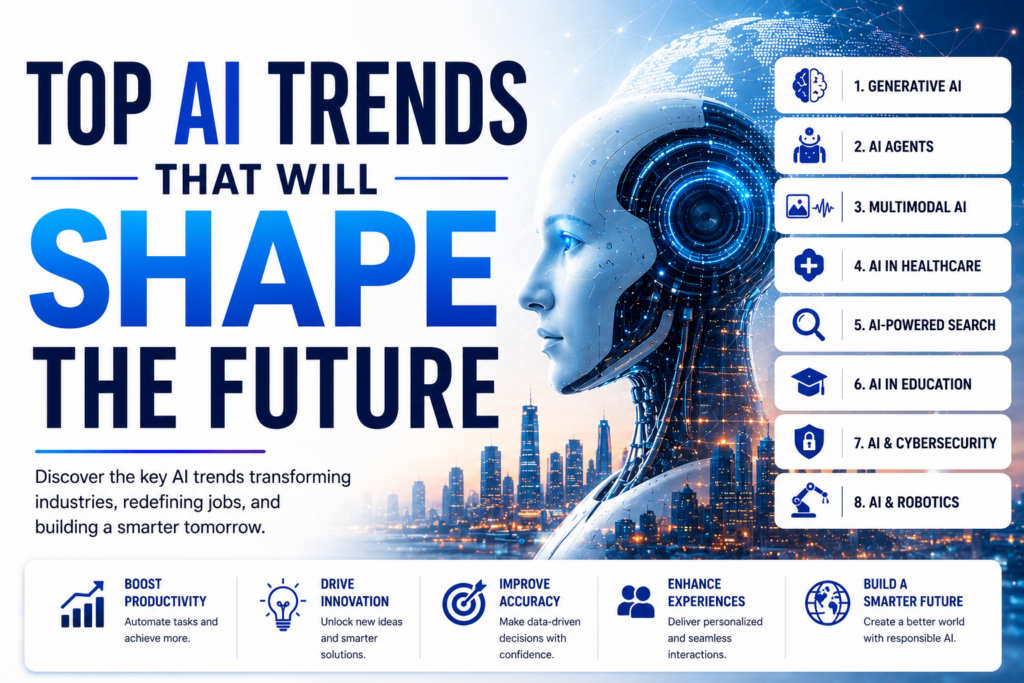
In this comprehensive guide, we’ll explore the top AI trends that will shape the future, why they matter, and how individuals and businesses can prepare for the AI-powered era.
Why AI Is Growing Faster Than Ever
Several factors have accelerated AI adoption worldwide:
- More powerful computing hardware
- Massive availability of digital data
- Cloud computing
- Better machine learning algorithms
- Generative AI breakthroughs
- Increased business investment
- Open-source AI models
- Enterprise AI platforms
These developments have made AI more affordable, accessible, and practical than ever before.
1. Generative AI Will Become a Daily Productivity Tool
Generative AI has already changed how people write, design, code, and brainstorm ideas.
Instead of replacing professionals, modern AI acts as an intelligent assistant that helps people complete tasks faster and with better quality.
Examples include:
- Writing blog articles
- Creating marketing content
- Designing presentations
- Generating images
- Producing videos
- Writing software code
- Summarizing documents
- Translating languages
Businesses increasingly use AI to reduce repetitive work while allowing employees to focus on creativity and strategic thinking.
Industries benefiting the most
- Marketing
- Education
- Software Development
- Healthcare
- Customer Support
- Media
- Publishing
As AI models become more accurate, personalized, and multimodal, they will become standard workplace tools.
2. AI Agents Will Perform Complex Tasks Independently
One of the biggest trends for the future is the rise of AI agents.
Unlike traditional chatbots that simply answer questions, AI agents can:
- Plan tasks
- Complete multi-step workflows
- Access different applications
- Analyze information
- Make recommendations
- Work with minimal supervision
Also Read :- 20 AI Prompts Everyone Should Know in 2026 to Save Time and Work Smarter
Imagine telling an AI:
“Plan my business trip, compare flights, book hotels within budget, organize meetings, and prepare the itinerary.”
Future AI agents will handle all these tasks automatically.
Businesses are already investing heavily in AI-powered digital employees capable of managing customer service, HR tasks, finance operations, and internal workflows.
3. Multimodal AI Will Become the New Standard
Earlier AI systems worked with only one type of input, such as text.
Modern AI can now understand:
- Text
- Images
- Audio
- Videos
- Documents
- Voice conversations
This capability is called multimodal AI.
For example, a user can upload:
- A medical scan
- A spreadsheet
- A handwritten note
- A photo
- A voice recording
The AI can understand all of them together before producing a much more accurate response.
This significantly improves problem-solving capabilities across industries.
4. AI Will Revolutionize Healthcare
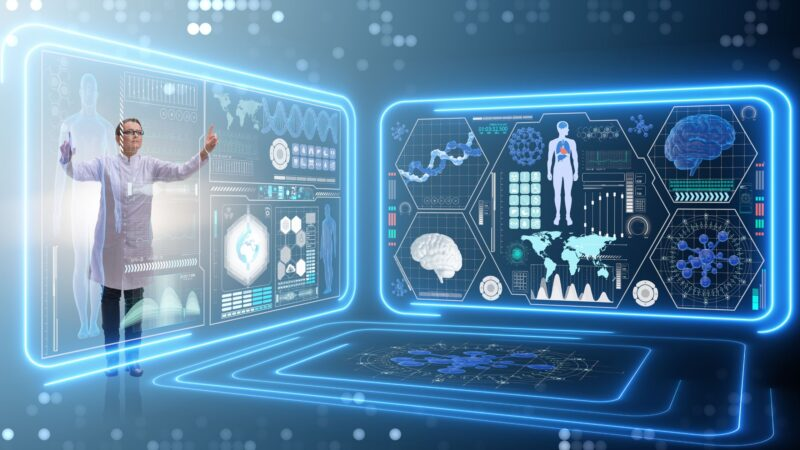
Healthcare is expected to experience one of the largest transformations through artificial intelligence.
AI is already helping doctors:
- Detect diseases earlier
- Analyze medical images
- Predict patient risks
- Recommend treatments
- Discover new drugs
- Improve hospital operations
Future applications may include:
Personalized medicine
AI will analyze an individual’s:
- DNA
- Lifestyle
- Medical history
- Environment
to recommend customized treatments.
Faster diagnosis
Medical imaging AI continues to improve the detection of:
- Cancer
- Heart disease
- Eye disorders
- Neurological conditions
Earlier diagnosis often leads to better treatment outcomes.
5. AI-Powered Search Will Replace Traditional Search Engines
Instead of browsing through dozens of links, users increasingly prefer conversational AI search experiences.
Future search systems will:
- Understand context
- Remember previous questions
- Summarize information
- Compare products
- Explain complex topics
- Generate personalized answers
This will fundamentally change how people access information online.
Businesses will also need to optimize content not just for traditional search engines but also for AI-powered search assistants.
6. AI Will Transform Education
Education is becoming increasingly personalized thanks to AI.
Instead of one-size-fits-all teaching methods, AI can create customized learning experiences based on each student’s:
- Skill level
- Learning pace
- Weak areas
- Interests
Future AI tutors may provide:
- Instant explanations
- Practice quizzes
- Personalized study plans
- Homework assistance
- Language learning
- Exam preparation
Teachers will also benefit from AI tools that automate grading, lesson planning, and classroom management.
7. AI Will Improve Cybersecurity
As cyber threats become more sophisticated, AI is becoming an essential defense mechanism.
Modern AI systems can detect:
- Suspicious network activity
- Malware
- Phishing attempts
- Fraudulent transactions
- Identity theft
- Data breaches
Unlike traditional security software, AI continuously learns from new attack patterns.
Also Read :- Best AI Tools for Students in 2026
Organizations increasingly rely on AI for real-time threat detection and faster incident response.
8. AI Will Accelerate Scientific Research
Scientists often spend years analyzing enormous datasets.
AI dramatically speeds up research by:
- Processing complex information
- Finding hidden patterns
- Running simulations
- Predicting outcomes
Fields benefiting include:
- Climate science
- Drug discovery
- Space exploration
- Material science
- Physics
- Chemistry
- Agriculture
AI can significantly reduce the time required for major discoveries.
9. Robotics Will Become More Intelligent
Robots powered by AI are becoming increasingly capable.
Future robots will be able to:
- Understand voice commands
- Navigate complex environments
- Handle delicate objects
- Collaborate safely with humans
- Learn new tasks independently
Industries already adopting AI robots include:
- Manufacturing
- Warehousing
- Logistics
- Agriculture
- Healthcare
- Hospitality
Humanoid robots are also receiving significant investment worldwide.
10. AI Will Transform Customer Service
Traditional customer support often involves long wait times.
AI-powered assistants now provide:
- 24/7 availability
- Instant responses
- Personalized recommendations
- Multilingual support
- Faster issue resolution
Future AI assistants will understand customer emotions, previous interactions, and preferences to deliver highly personalized service experiences.
11. AI Will Change Software Development
Software engineering is rapidly evolving with AI coding assistants.
Developers increasingly use AI to:
- Write code
- Debug software
- Generate documentation
- Review code
- Detect vulnerabilities
- Build prototypes
Rather than replacing programmers, AI enables developers to spend more time solving complex problems instead of repetitive coding tasks.
12. Responsible AI Will Become a Major Priority
As AI becomes more powerful, governments and organizations are placing greater emphasis on responsible AI development.
Important areas include:
AI Transparency
Users should understand how AI reaches decisions.
Bias Reduction
Developers must reduce discrimination in AI systems.
Privacy Protection
Organizations need stronger safeguards for user data.
Human Oversight
Critical decisions should still involve human review.
Responsible AI will become essential for maintaining public trust.
13. AI in Finance Will Continue Expanding
Banks and financial institutions increasingly rely on AI.
Applications include:
- Fraud detection
- Credit risk analysis
- Investment recommendations
- Customer support
- Loan processing
- Financial forecasting
AI enables faster and more accurate financial decisions while improving customer experiences.
14. AI Will Personalize Online Shopping
E-commerce companies use AI to understand customer preferences.
Future AI shopping assistants will:
- Recommend products
- Predict future purchases
- Compare prices
- Provide virtual try-ons
- Manage shopping lists
- Negotiate discounts
This creates a highly personalized shopping experience.
15. AI-Powered Content Creation Will Continue Growing
Content creators now use AI for:
- Blog writing
- Video editing
- Podcast production
- Graphic design
- Social media posts
- Advertising campaigns
Rather than replacing creativity, AI helps creators produce content faster while allowing them to focus on strategy and storytelling.
16. AI Will Improve Smart Homes and Smart Cities
Smart devices continue becoming more intelligent.
Future AI systems may optimize:
Homes
- Energy usage
- Security
- Lighting
- Heating
- Appliances
Cities
- Traffic management
- Public transport
- Waste management
- Emergency response
- Energy distribution
These improvements can make urban living safer, more efficient, and more sustainable.
17. AI Will Reshape the Job Market
AI will automate certain repetitive tasks, but it will also create entirely new career opportunities.
Growing AI-related roles include:
- AI Engineers
- Prompt Engineers
- AI Product Managers
- Machine Learning Engineers
- Data Scientists
- AI Ethics Specialists
- Automation Consultants
- AI Trainers
Professionals who learn to work alongside AI are likely to have a competitive advantage in the future workforce.
Challenges AI Still Faces
Despite its rapid progress, AI also presents several challenges:
- Data privacy concerns
- Algorithmic bias
- Misinformation
- Hallucinations in AI-generated content
- Copyright issues
- Job displacement in certain sectors
- Regulatory uncertainty
- High computational costs
Addressing these challenges will be essential for responsible AI adoption.
How Individuals Can Prepare for the AI Future
The AI revolution is not only for technology experts. Anyone can benefit by developing AI-related skills.
Practical ways to prepare include:
- Learn AI fundamentals.
- Experiment with AI productivity tools.
- Improve digital literacy.
- Develop critical thinking skills.
- Learn prompt writing techniques.
- Stay updated with AI news and research.
- Focus on creativity and problem-solving.
- Build skills that complement AI rather than compete with it.
Continuous learning will become one of the most valuable career assets.
The Future of AI: What Lies Ahead?
The coming decade will likely bring AI systems that are more capable, collaborative, and integrated into everyday life. From personalized healthcare and smarter education to advanced robotics and scientific breakthroughs, AI has the potential to improve productivity, solve complex global challenges, and enhance the quality of life for millions.
At the same time, realizing these benefits will require thoughtful governance, responsible development, and a continued focus on transparency, privacy, and human oversight. The organizations and individuals who embrace AI while using it ethically will be best positioned to thrive in this rapidly evolving landscape.
Frequently Asked Questions (FAQs)
What are the biggest AI trends in 2026?
Some of the biggest AI trends include generative AI, AI agents, multimodal AI, personalized healthcare, AI-powered search, robotics, cybersecurity, and responsible AI governance.
Will AI replace human jobs?
AI is expected to automate some repetitive tasks, but it is also creating new roles and changing existing jobs. Many experts believe AI will augment human work rather than replace it entirely.
Which industries will benefit most from AI?
Healthcare, finance, education, manufacturing, retail, logistics, cybersecurity, software development, and customer service are among the industries seeing the greatest impact.
What is multimodal AI?
Multimodal AI refers to systems that can understand and combine multiple forms of input—such as text, images, audio, video, and documents—to provide more accurate and context-aware responses.
Why is responsible AI important?
Responsible AI helps ensure that AI systems are fair, transparent, secure, and respectful of user privacy while reducing the risks of bias and misuse.