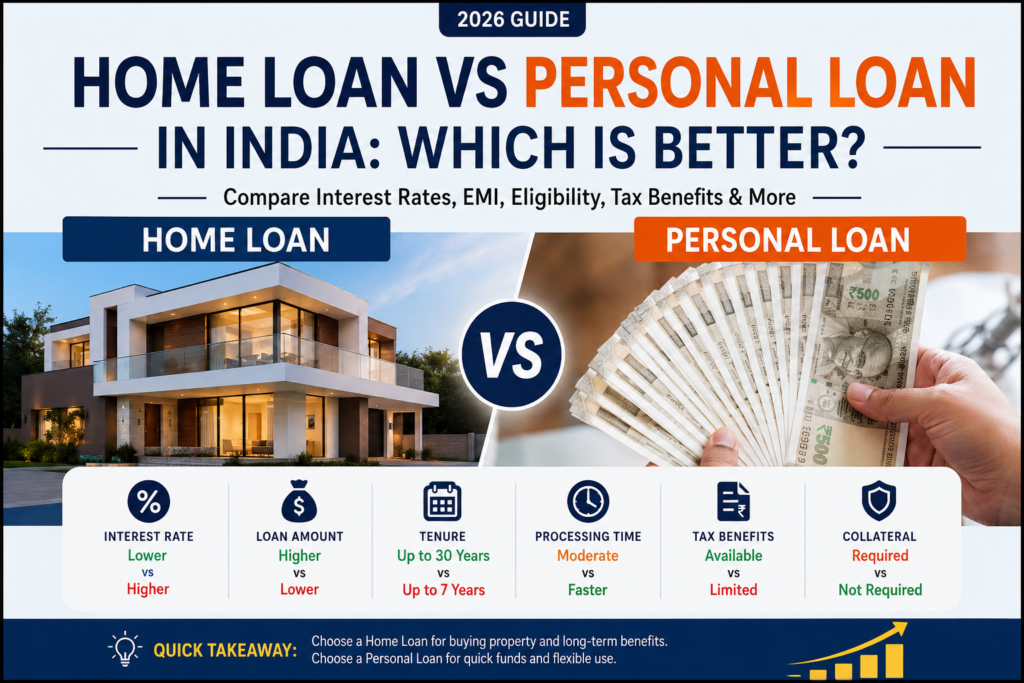
Buying a home is one of the biggest financial milestones in life. At the same time, there are moments when you need quick funds for emergencies, education, weddings, travel, or home renovation. In such situations, choosing the right type of loan can save you thousands—or even lakhs—of rupees over time.
One of the most common questions borrowers ask is: Should I take a home loan or a personal loan?
Although both help you borrow money, they serve different purposes. A home loan is specifically designed for purchasing or constructing residential property and is backed by the property itself. A personal loan, on the other hand, is an unsecured loan that offers flexibility and can be used for almost any personal financial need.
Selecting the wrong loan may result in higher interest costs, larger monthly EMIs, and unnecessary financial stress. That’s why understanding the differences is essential before applying.
In this detailed guide, we’ll compare Home Loan vs Personal Loan in India based on interest rates, eligibility, repayment tenure, tax benefits, approval process, documentation, advantages, disadvantages, and real-life scenarios. By the end of this article, you’ll have a clear understanding of which loan best suits your financial goals.
What Is a Home Loan?
A home loan is a secured loan provided by banks, housing finance companies (HFCs), and NBFCs to help individuals purchase, construct, renovate, or extend a residential property.
Since the property serves as collateral, lenders face lower risk. As a result, home loans generally come with lower interest rates and longer repayment tenures than unsecured loans.
Common Uses of a Home Loan
A home loan can be used for:
- Buying a new house or apartment
- Purchasing a resale property
- Constructing a house on owned land
- Renovating or repairing an existing home
- Extending a house by adding extra rooms or floors
- Purchasing a residential plot (subject to lender policies)
Because the loan amount is often substantial, lenders evaluate several factors before approval, including income, employment stability, credit score, and the legal status of the property.
What Is a Personal Loan?
A personal loan is an unsecured loan, meaning you don’t have to pledge any asset as collateral.
Instead, the lender evaluates your repayment ability based on your:
- Monthly income
- Employment status
- Credit score
- Existing financial obligations
- Loan repayment history
Since there is no security involved, lenders charge higher interest rates compared to home loans.
The biggest advantage of a personal loan is flexibility. Unlike a home loan, there are usually no restrictions on how you use the money.
Popular Reasons for Taking a Personal Loan
People commonly use personal loans for:
- Medical emergencies
- Wedding expenses
- Higher education
- Travel and vacations
- Home renovation or interiors
- Purchasing appliances or electronics
- Debt consolidation
- Unexpected financial needs
Many banks also offer instant pre-approved personal loans to eligible customers, making them one of the fastest financing options available.
Home Loan vs Personal Loan: Key Differences

Although both loans provide financial assistance, they differ significantly in terms of purpose, cost, repayment, and eligibility.
| Feature | Home Loan | Personal Loan |
|---|---|---|
| Loan Type | Secured | Unsecured |
| Collateral | Property Required | No Collateral |
| Purpose | Buying or constructing property | Any personal financial need |
| Interest Rate | Lower | Higher |
| Loan Amount | Higher | Lower |
| Repayment Tenure | Up to 30 years | Usually up to 7 years |
| Processing Time | Moderate | Fast |
| Tax Benefits | Available (subject to applicable tax laws) | Limited and purpose-dependent |
| EMI | Lower due to longer tenure | Higher due to shorter tenure |
From the table above, it’s clear that each loan is designed for a different purpose. The better choice depends on your financial objective rather than just the interest rate.
Understanding the Biggest Difference: Secured vs Unsecured Loan
The most important distinction between a home loan and a personal loan is security.
Home Loan: A Secured Loan
When you take a home loan, the property being financed acts as security for the lender.
If the borrower consistently fails to repay the loan, the lender has legal remedies available under applicable laws and the terms of the loan agreement, which may include enforcing its security interest in the property.
Because of this reduced lending risk, banks are generally willing to offer:
- Lower interest rates
- Higher loan amounts
- Longer repayment periods
This makes home loans one of the most affordable borrowing options available for long-term financing.
Also Read :- Best Personal Loan Apps for Salaried Employees in India
Personal Loan: An Unsecured Loan
A personal loan does not require any collateral.
While this makes borrowing more convenient, it also increases the lender’s risk. To compensate, lenders generally charge higher interest rates and may offer shorter repayment periods.
However, the absence of collateral means borrowers can obtain funds without mortgaging any asset, making personal loans ideal for urgent or short-term financial requirements.
Interest Rates: Which Loan Costs Less?
Interest rate is one of the biggest factors affecting the overall cost of borrowing.
Home Loan Interest Rates
Home loans usually offer comparatively lower interest rates because the lender has the security of the property.
Depending on factors such as your credit profile, income, loan amount, and lender policies, home loan interest rates are generally much lower than those of unsecured loans.
Personal Loan Interest Rates
Since personal loans do not involve collateral, lenders take on greater risk. This typically results in higher interest rates compared to home loans.
Your exact rate depends on:
- Credit score
- Monthly income
- Employment stability
- Existing EMIs
- Relationship with the lender
Borrowers with an excellent credit history often receive more competitive rates than those with weaker credit profiles.
Why Interest Rate Matters
Even a small difference in interest rates can significantly affect the total amount you repay over the life of the loan.
For example, a loan with a lower interest rate can save borrowers a substantial amount in interest over several years, especially when borrowing larger sums.
If minimizing borrowing costs is your priority, a home loan is generally the more economical choice for eligible property-related expenses.
Loan Amount: Which Offers More Funding?
The amount you can borrow also differs considerably between these two loan types.
Home Loan
Home loans are designed to finance high-value assets like residential properties.
Depending on your repayment capacity and the property’s value, lenders may sanction significantly larger loan amounts than they would for unsecured borrowing.
Personal Loan
Personal loans are typically meant for smaller financial requirements.
Although loan limits have increased in recent years, the sanctioned amount primarily depends on your income and repayment capacity.
For borrowers planning to purchase a home, a personal loan is generally not practical because the approved amount may not be sufficient, and the repayment burden can become much higher due to shorter loan tenures.
Repayment Tenure: How Long Do You Get to Repay?
Repayment tenure directly affects your monthly EMI and your overall financial planning.
Home Loan Tenure
One of the biggest advantages of a home loan is its long repayment period.
Many lenders offer repayment tenures extending up to 30 years, allowing borrowers to spread repayments over a longer duration. This often results in lower monthly EMIs, making home ownership more affordable for salaried and self-employed individuals alike.
A longer tenure can also improve loan eligibility by reducing the monthly repayment burden, though it may increase the total interest paid over the life of the loan.
Personal Loan Tenure
Personal loans usually have much shorter repayment periods, often ranging from 1 to 7 years, depending on the lender and the borrower’s profile.
Because the loan must be repaid within a shorter timeframe, the monthly EMI is generally higher than that of a home loan for a comparable loan amount.
This shorter tenure helps borrowers become debt-free sooner, but it also requires stronger monthly cash flow to comfortably manage repayments.
EMI Comparison: Which Loan Has Lower Monthly Payments?
For most borrowers, the monthly EMI (Equated Monthly Installment) is one of the biggest deciding factors when choosing between a home loan and a personal loan.
Even if two loans have the same principal amount, your EMI can vary significantly depending on the interest rate and repayment tenure.
Home Loan EMI
Home loans generally have:
- Lower interest rates
- Longer repayment tenures
- Lower monthly EMIs
For example, if you borrow ₹20 lakh through a home loan with a long repayment period, the EMI is usually much more manageable because the repayment is spread over many years.
This makes home loans suitable for people who want to keep their monthly financial commitments under control while investing in a valuable long-term asset.
Personal Loan EMI
Personal loans generally have:
- Higher interest rates
- Shorter repayment periods
- Higher monthly EMIs
Although you’ll repay the loan faster, your monthly financial burden can be considerably higher.
Also Read :- 10 Best Zero Balance Savings Accounts in India You Should Know About (2026)
This is one reason personal loans are typically recommended for short-term financial needs rather than high-value purchases like a house.
Which EMI Is Better?
If your goal is to keep your monthly outflow lower, a home loan usually offers a clear advantage due to its longer tenure and lower interest rates.
However, if you prefer becoming debt-free quickly and can comfortably afford a higher EMI, a personal loan may be a suitable choice for smaller funding requirements.
Eligibility Criteria: Home Loan vs Personal Loan
Every lender has its own eligibility guidelines, but some common requirements apply across most banks and financial institutions.
Home Loan Eligibility
To qualify for a home loan, lenders generally consider:
- Age of the applicant
- Stable income
- Employment status (salaried or self-employed)
- Credit score
- Existing financial obligations
- Property value
- Property’s legal and technical verification
- Loan-to-Value (LTV) ratio
Lenders also assess whether the property’s documents are legally clear before approving the loan.
Personal Loan Eligibility
For personal loans, lenders primarily evaluate the borrower’s financial profile instead of any asset.
Common factors include:
- Monthly income
- Job stability
- Employer category
- Credit score
- Existing EMIs
- Repayment history
- Debt-to-income ratio
Since no property verification is required, personal loan approvals are generally faster.
Documentation Required
Preparing your documents in advance can speed up the approval process.
Documents Required for a Home Loan
Although requirements vary slightly across lenders, applicants are usually asked to provide:
- PAN Card
- Aadhaar Card or other identity proof
- Address proof
- Passport-size photographs
- Salary slips (for salaried applicants)
- Income Tax Returns (for self-employed applicants)
- Bank statements
- Employment proof or business proof
- Property documents
- Sale agreement
- Builder-related documents (if applicable)
Because property verification is involved, the documentation process is naturally more extensive.
Documents Required for a Personal Loan
Personal loans generally require fewer documents, such as:
- PAN Card
- Aadhaar Card
- Identity proof
- Address proof
- Income proof
- Salary slips
- Bank statements
- Employment proof
Since there is no collateral involved, paperwork is comparatively simple.
Processing Time: Which Loan Is Faster?
Many borrowers require funds urgently.
In such cases, the approval speed becomes extremely important.
Home Loan Processing Time
Home loans usually take longer because lenders must complete several additional checks.
These include:
- Property valuation
- Legal verification
- Technical inspection
- Income verification
- Credit assessment
- Document review
Depending on the lender and the complexity of the transaction, approval and disbursement may take several days or even weeks.
Personal Loan Processing Time
Personal loans are among the fastest financial products available.
Many banks and NBFCs now offer:
- Digital applications
- Instant eligibility checks
- Paperless verification
- Online document uploads
Pre-approved customers may even receive loan approval within a short time, subject to the lender’s processes and verification requirements.
Winner
If speed is your priority, personal loans usually have the advantage.
Tax Benefits: Which Loan Saves More Money?
Tax savings are one of the biggest reasons why home loans remain popular among Indian borrowers.
Home Loan Tax Benefits
Eligible borrowers may claim tax deductions on:
- Home loan interest
- Principal repayment
These benefits are available only if the borrower satisfies the conditions prescribed under the applicable provisions of the Income Tax Act and follows the prevailing tax regime.
Because tax laws may change over time, it’s advisable to consult a qualified tax professional before making financial decisions based on tax deductions.
Personal Loan Tax Benefits
Unlike home loans, personal loans generally do not offer direct tax benefits.
However, deductions may be available in specific situations if the loan is used for eligible purposes recognized under tax laws, such as certain business or asset-related uses.
For general personal expenses like weddings, vacations, or consumer purchases, tax deductions are typically not available.
Winner
For borrowers seeking long-term tax advantages, home loans are generally the better option.
Loan Purpose: Which Loan Offers More Flexibility?
Purpose plays a crucial role when deciding between the two.
Home Loan
A home loan must be used for approved housing-related purposes, such as:
- Purchasing a house
- Buying an apartment
- Constructing a home
- Home renovation
- Home extension
- Certain plot purchases, subject to lender policies
Using a home loan for unrelated personal expenses is generally not permitted.
Personal Loan
One of the biggest advantages of a personal loan is flexibility.
Borrowers may use the funds for various legitimate personal needs, including:
- Medical emergencies
- Wedding expenses
- Higher education
- International travel
- Debt consolidation
- Home interiors
- Household appliances
- Family emergencies
There is usually no requirement to explain every expense after disbursement, although lenders may ask about the intended purpose during the application process.
Winner
When flexibility matters most, personal loans clearly stand out.
Advantages of a Home Loan
A home loan offers several long-term financial benefits.
Lower Interest Rates
Compared to unsecured borrowing, home loans are generally more affordable.
Higher Loan Amount
Suitable for financing expensive residential properties.
Longer Repayment Tenure
Repayment periods extending up to 30 years help reduce monthly EMI pressure.
Potential Tax Benefits
Eligible borrowers may receive tax deductions under applicable laws.
Asset Creation
Unlike many other loans, a home loan helps you acquire a long-term appreciating asset.
Better Financial Planning
Lower EMIs make it easier to balance household expenses and savings.
Advantages of a Personal Loan
Personal loans are designed for speed and convenience.
Quick Approval
Ideal during emergencies.
Minimal Documentation
Less paperwork than secured loans.
No Collateral Required
No need to mortgage your property or pledge valuable assets.
Flexible Usage
Funds can be used for multiple legitimate personal requirements.
Faster Disbursal
Digital lending has made personal loans one of the quickest financing options.
Disadvantages of a Home Loan
Despite its benefits, a home loan has certain drawbacks.
- Longer approval process
- Extensive documentation
- Property verification required
- Down payment is usually necessary
- Legal scrutiny of property documents
- Long repayment commitment
Borrowers should carefully assess their long-term repayment capacity before taking a large home loan.
Disadvantages of a Personal Loan
Personal loans also come with limitations.
- Higher interest rates
- Higher monthly EMIs
- Short repayment tenure
- Lower borrowing limits
- Limited tax advantages
- More expensive over time for large borrowing needs
For financing a property purchase, relying solely on a personal loan is generally not cost-effective.
Which Loan Is Better for Your Credit Score?
Both home loans and personal loans can influence your credit profile.
Timely repayments on either loan demonstrate responsible borrowing behavior and can contribute positively to your credit history.
However, missing EMIs, defaulting on payments, or borrowing beyond your repayment capacity can negatively impact your credit score, regardless of the loan type.
Also Read :- Best UPI Apps in India (2026)
To maintain a healthy credit profile:
- Pay EMIs on time.
- Avoid excessive borrowing.
- Keep your credit utilization under control.
- Monitor your credit report regularly.
- Maintain a balanced mix of secured and unsecured credit where appropriate.
A strong credit score not only improves approval chances but may also help you secure better interest rates in the future.
Home Loan vs Personal Loan: Which Is Better?
There isn’t a single answer that fits everyone. The better option depends on why you need the money, how much you need, and how comfortably you can repay it.
A home loan is specifically designed for purchasing or constructing residential property and offers lower interest rates, longer repayment periods, and potential tax benefits. A personal loan, on the other hand, is ideal when you need quick access to funds for expenses that are not related to buying a home.
Let’s look at different situations to understand which loan makes more sense.
Scenario 1: You’re Buying Your Dream Home
Suppose you’ve found your ideal apartment or house and need financial assistance to purchase it.
In this situation, a home loan is almost always the better choice because it is designed specifically for property purchases. It generally offers:
- Lower interest rates
- Higher loan amounts
- Longer repayment tenures
- Lower monthly EMIs
- Potential tax benefits
Using a personal loan for buying a house is usually not practical because the approved loan amount may be insufficient, and the higher interest rates can significantly increase your repayment burden.
Best Choice: Home Loan ✅
Scenario 2: You Need Money for a Medical Emergency
Unexpected medical expenses often require immediate financial support.
Since personal loans can usually be processed much faster than home loans, they are often a better option during emergencies.
Many lenders offer:
- Online applications
- Instant eligibility checks
- Quick approvals
- Faster disbursal for eligible applicants
Speed matters in emergencies, making a personal loan the preferred option.
Best Choice: Personal Loan ✅
Scenario 3: You Want to Renovate Your Home
If you’re planning to renovate your kitchen, redesign your interiors, or repair your existing house, both loan options could be relevant.
Some lenders offer home loans or dedicated home improvement loans for renovation projects, which may provide more competitive terms than unsecured borrowing.
However, if your renovation budget is relatively small and you need funds urgently, a personal loan may offer greater convenience.
Choose a Home Loan If:
- Renovation costs are substantial.
- You qualify for a home improvement loan.
- You prefer lower interest rates.
Choose a Personal Loan If:
- The renovation is minor.
- You need funds quickly.
- You want minimal documentation.
Scenario 4: Wedding Expenses
Indian weddings often involve significant expenses, including venue bookings, catering, jewellery, travel, and decorations.
Since these costs are unrelated to purchasing property, a home loan is generally not suitable.
A personal loan provides the flexibility needed to manage wedding-related expenses.
Best Choice: Personal Loan ✅
Scenario 5: Higher Education
If you’re funding higher education and an education loan is not available or does not meet your requirements, some borrowers consider personal loans.
However, before choosing a personal loan, compare it with education loan options, as education loans may offer benefits such as lower interest rates or repayment flexibility.
If a personal loan is your preferred choice, ensure the EMI fits comfortably within your budget.
Best Choice: Usually Personal Loan (after comparing alternatives)
Scenario 6: Buying Residential Property as an Investment
Whether you’re purchasing your first home or investing in residential real estate, a home loan is generally the more appropriate financing option.
Besides lower borrowing costs, many borrowers appreciate the structured repayment schedule and the opportunity to build a valuable long-term asset.
Best Choice: Home Loan ✅
Home Loan vs Personal Loan: Side-by-Side Comparison
| Comparison Factor | Home Loan | Personal Loan |
|---|---|---|
| Best For | Buying or constructing property | Personal financial needs |
| Interest Rates | Usually Lower | Usually Higher |
| Processing Speed | Moderate | Faster |
| Collateral | Required | Not Required |
| Loan Amount | Higher | Lower |
| Repayment Period | Up to 30 Years | Usually Up to 7 Years |
| Tax Benefits | Available (subject to applicable laws) | Limited and purpose-dependent |
| Documentation | More Extensive | Comparatively Simple |
| Monthly EMI | Generally Lower | Generally Higher |
| Flexibility | Limited to housing purposes | Highly Flexible |
Home Loan vs Personal Loan for Salaried Employees
Salaried professionals often have access to both home loans and personal loans, depending on their income, credit score, and employment stability.
Home Loan May Be Better If You:
- Are purchasing a house.
- Have a stable monthly income.
- Plan to stay in the property long-term.
- Want lower EMIs.
- Wish to benefit from applicable tax provisions.
Personal Loan May Be Better If You:
- Need funds urgently.
- Require a smaller loan amount.
- Don’t want to mortgage any asset.
- Need financing for expenses unrelated to property.
Home Loan vs Personal Loan for Self-Employed Individuals
Self-employed applicants may qualify for both loan types, although lenders often evaluate business income stability, financial statements, and repayment capacity more closely.
Maintaining accurate financial records and a healthy credit profile can improve approval chances.
A home loan is generally suitable for purchasing or constructing property, while a personal loan is more appropriate for short-term business or personal financial needs.
Can You Have Both a Home Loan and a Personal Loan?
Yes.
Many borrowers in India successfully manage both loans simultaneously.
For example:
- A home loan may be used to purchase a property.
- A personal loan may later help finance furniture, home interiors, or emergency expenses.
However, lenders carefully evaluate your overall repayment capacity before approving additional borrowing.
Before taking multiple loans, ask yourself:
- Can I comfortably manage both EMIs?
- Will my emergency savings remain adequate?
- Will the new loan affect my long-term financial goals?
Borrow only what you genuinely need and avoid overextending your finances.
Common Mistakes Borrowers Make
Many people focus only on loan approval and overlook important financial details.
Avoid these common mistakes:
1. Choosing Based Only on Interest Rate
A lower interest rate is important, but you should also compare:
- Processing fees
- Foreclosure charges
- Prepayment rules
- Insurance costs (if applicable)
- Total repayment amount
2. Borrowing More Than Required
Taking a larger loan than necessary increases your interest burden and monthly commitments.
Borrow according to your actual needs and repayment ability.
3. Ignoring Your Credit Score
A strong credit score can improve your chances of approval and may help you secure more competitive loan terms.
Before applying, review your credit report and resolve any discrepancies.
4. Not Comparing Multiple Lenders
Different lenders may offer varying:
- Interest rates
- Processing fees
- Loan tenures
- Customer service
- Prepayment options
Comparing offers can help you make a more informed decision.
5. Choosing the Wrong EMI
An EMI that consumes too much of your monthly income can create financial stress.
As a general budgeting principle, ensure your total loan obligations remain manageable alongside your regular living expenses and savings goals.
Frequently Asked Questions (FAQs)
Which loan is cheaper: Home Loan or Personal Loan?
In most cases, a home loan is cheaper because it generally carries lower interest rates than a personal loan.
Which loan gets approved faster?
Personal loans are usually approved faster because they do not require property verification.
Can I use a personal loan to buy a house?
While a personal loan can technically be used for many personal expenses, it is generally not a practical way to finance an entire house due to lower loan limits, higher interest rates, and shorter repayment tenures.
Which loan has lower EMI?
Home loans generally have lower EMIs because repayment is spread over a much longer period.
Is collateral required for a personal loan?
No. Personal loans are unsecured and typically do not require collateral.
Which loan is easier to qualify for?
Eligibility depends on your income, credit score, employment status, and the lender’s policies. Personal loans usually involve fewer verification steps, while home loans require additional property-related checks.
Can prepaying the loan save money?
Yes. Depending on your lender’s terms and applicable charges, making prepayments can reduce the outstanding principal and lower the total interest paid over the life of the loan.
Expert Tips Before Choosing Any Loan
Whether you are applying for a home loan or a personal loan, making an informed decision can save you money and reduce financial stress. Here are some practical tips to help you borrow wisely.
1. Know Exactly Why You Need the Loan
The first step is identifying the purpose of borrowing.
If your goal is to buy, construct, or renovate a home, a home loan is generally the most suitable option. For expenses such as medical emergencies, weddings, education, travel, or debt consolidation, a personal loan is often more appropriate.
Choosing the right loan product helps you benefit from the features designed for that specific purpose.
2. Compare Multiple Lenders
Never apply to the first lender you come across.
Before making a decision, compare:
- Interest rates
- Processing fees
- Loan tenure
- Prepayment and foreclosure charges
- Customer reviews
- Digital services
- Loan approval timelines
Even a small difference in interest rates can result in substantial savings over the life of the loan.
3. Check Your Credit Score First
Your credit score plays a major role in loan approval and pricing.
A healthy score can improve your chances of approval and may help you receive more competitive interest rates.
If your score is lower than expected:
- Clear overdue payments.
- Reduce outstanding debt where possible.
- Avoid applying for multiple loans at the same time.
- Review your credit report for errors and get them corrected.
Improving your credit profile before applying can strengthen your application.
4. Calculate Your EMI Before Applying
Many borrowers focus only on the loan amount and overlook the monthly repayment commitment.
Before submitting your application:
- Estimate your monthly EMI.
- Compare it with your monthly income.
- Consider existing EMIs and household expenses.
- Keep room for savings and emergencies.
Borrow only an amount you can comfortably repay without affecting your long-term financial stability.
5. Read the Loan Agreement Carefully
Loan agreements contain important information that borrowers sometimes ignore.
Pay attention to:
- Interest rate type (fixed or floating, if applicable)
- Processing fees
- Late payment charges
- Prepayment conditions
- Foreclosure rules
- Insurance requirements (if any)
Understanding these terms can help you avoid unexpected costs later.
When Should You Choose a Home Loan?
A home loan is generally the better option if:
- You are purchasing your first home.
- You want to construct a house.
- You are buying residential property as an investment.
- You need a higher loan amount.
- You prefer lower interest rates.
- You want a longer repayment period.
- You wish to benefit from applicable tax provisions.
- You are comfortable with a long-term financial commitment.
For most property-related needs, a home loan remains the most cost-effective financing option.
When Should You Choose a Personal Loan?
A personal loan may be a better choice if:
- You need funds urgently.
- The amount required is relatively small.
- You do not want to pledge any collateral.
- You need money for medical emergencies.
- You are financing a wedding or higher education.
- You are planning a vacation.
- You want to consolidate existing debt.
- You need funds for home interiors or household expenses.
The convenience and speed of personal loans make them suitable for short-term financial requirements.
Home Loan vs Personal Loan: Quick Decision Guide
Choose a Home Loan if you:
- ✔ Want to buy a house
- ✔ Need a large loan amount
- ✔ Prefer lower interest rates
- ✔ Want lower EMIs
- ✔ Plan to repay over a longer period
- ✔ Want to build a long-term asset
Choose a Personal Loan if you:
- ✔ Need money quickly
- ✔ Do not have collateral
- ✔ Want flexible usage
- ✔ Need funds for personal expenses
- ✔ Can comfortably manage higher EMIs
- ✔ Require a shorter repayment period
Final Comparison at a Glance
| Factor | Home Loan | Personal Loan |
|---|---|---|
| Purpose | Property purchase, construction, renovation | Personal expenses |
| Security | Property required | No collateral |
| Interest Rate | Usually lower | Usually higher |
| Loan Amount | Higher | Lower |
| EMI | Lower | Higher |
| Repayment Tenure | Up to 30 years | Usually up to 7 years |
| Processing Speed | Moderate | Faster |
| Documentation | Extensive | Minimal |
| Tax Benefits | Available under applicable tax laws | Limited and purpose-dependent |
| Flexibility | Limited | High |
Frequently Asked Questions (Additional FAQs)
Can I apply for both a home loan and a personal loan at the same time?
Yes. Many borrowers hold both loans simultaneously, provided they meet the lender’s eligibility criteria and have sufficient repayment capacity.
Which loan is better for first-time home buyers?
A home loan is generally the preferred option for first-time home buyers because it is specifically designed for property purchases and typically offers lower borrowing costs than unsecured loans.
Can self-employed individuals get a home loan?
Yes. Self-employed professionals and business owners can apply for home loans by providing the financial documents required by the lender, such as income proof, bank statements, and tax returns.
Does taking a loan affect my credit score?
Applying for a loan may result in a credit inquiry. More importantly, your repayment behavior has a lasting impact. Timely EMI payments can contribute positively to your credit history, while missed or delayed payments may negatively affect your score.
Which loan is better for home renovation?
It depends on the project size. For major renovations, a home improvement loan or eligible home loan option may be more cost-effective. For smaller projects requiring quick funding, a personal loan may be suitable.
Can I repay my loan before the tenure ends?
Many lenders allow partial or full prepayment, though the terms and any applicable charges vary. Always review your lender’s prepayment policy before applying.
Final Verdict
When comparing Home Loan vs Personal Loan in India, there is no universal winner. The right choice depends on your financial goals, the purpose of borrowing, and your repayment capacity.
If you are planning to purchase, construct, or substantially renovate a house, a home loan is generally the smarter financial decision. It offers lower interest rates, higher loan amounts, longer repayment tenures, and potential tax benefits, making it one of the most affordable long-term borrowing options.
On the other hand, if you need immediate funds for expenses such as medical emergencies, weddings, travel, education, or debt consolidation, a personal loan provides speed, flexibility, and convenience without requiring any collateral.
Before signing any loan agreement, compare offers from multiple lenders, evaluate the total cost of borrowing—not just the advertised interest rate—and choose an EMI that comfortably fits within your monthly budget. Borrow responsibly, maintain a strong credit profile, and select the loan that aligns with your long-term financial well-being.
Conclusion
Choosing between a home loan and a personal loan isn’t about deciding which one is universally better—it’s about selecting the loan that matches your specific needs.
A home loan is designed to help you achieve the dream of homeownership while keeping borrowing costs relatively low over a longer repayment period. A personal loan, meanwhile, offers quick access to funds and greater flexibility for life’s unexpected expenses and short-term financial goals.
By understanding the differences in interest rates, repayment tenure, eligibility, documentation, tax implications, and loan purpose, you can make a well-informed decision that supports your financial future.
Whether you’re buying your first home or managing an urgent expense, always borrow within your means, compare lenders carefully, and plan your repayments in advance. A well-chosen loan can become a valuable financial tool—one that helps you achieve your goals without placing unnecessary pressure on your finances.